Glossary · Module 1: Foundational Framework and Core Architecture · Term 2
Central Entity
The single subject every page of a Semantic Content Network points back to, explained with real sites and a way to choose yours.
Central Entity + Source Context = Core Section | Central Entity + Central Search Intent = Outer Section
Quick definition. The Central Entity is the single, sitewide, language agnostic anchor concept that exists across every page, URL path, and content brief in a Semantic Content Network. It sets the primary knowledge domain of the site for search engine parsers. Every other choice in the topical map, from the Source Context to the Core Section, is made around it.
Why the Central Entity matters
A website that covers everything is about nothing. A search engine has to decide what your domain is for before it decides where to rank you. The Central Entity answers that question for the whole site.
Koray Tuğberk GÜBÜR calls it the anchor of a Semantic Content Network. Every page, URL path, and content brief inherits it. It defines the primary knowledge domain of the site for the parsers that read your pages.
Without one, the site drifts. Koray warns about sites that chase traffic with no link to the business. His example is a personal injury law firm that publishes articles on a city’s history and local festivals. The articles dilute the site’s topic focus and confuse the search engine about what the firm does.
Choosing the Central Entity is therefore the first decision in the whole Topical Authority Formula. Coverage, historical data, and retrieval cost all measure themselves against it.
How it works with Source Context and Central Search Intent
Koray treats three terms as one structure. Each answers a different question about the site.
The Central Entity is the root noun. It does not change across the site. The Source Context is the commercial filter. It explains why your domain deserves to rank for a query. The Central Search Intent is the user purpose that joins the two, written as action verbs.
Source Context changes the map even when the entity stays the same. If the Central Entity is Germany, a visa consultant builds a map around immigration requirements. A travel agency builds one around hotels, flights, and sightseeing.
Core Section and Outer Section
Joining the Central Entity with the Source Context gives the Core Section. These are the monetization pages, such as tourist visas and student visas. They receive internal PageRank priority.
Joining the Central Entity with the secondary predicates of the search intent gives the Outer Section. These are the informational pages, such as living costs, culture, and education. They collect impressions, clicks, and dwell time, then pass that history up to the Core Section through contextual links.
Examples from real projects
Koray’s published case studies show the Central Entity at work. The figures below come from his talks, articles, and course material.
Two sector examples show the same pattern outside Koray’s case studies. A plaintiff trial law firm that specializes in birth injury litigation has the Central Entity Medical Malpractice. A financial advisory portal for senior investors has the Central Entity Retirement Planning.
Koray’s own sources add two more. For a YouTube SEO project the Central Entity is SEO. For the visa site it is also described as Germany plus Visa, which shows that a Central Entity can be a short compound, not only a single word.
The Vizem site grew across more than 190 country level semantic content networks built on the same pattern. The bottled water brand kept 400,000 organic clicks 3.5 years later, with a 10% lift from updating year numbers.
How to apply it
This order follows Koray’s implementation checklist and the course lectures.
- Select one Central Entity for the whole site. Pick a concept, not a keyword. It should be a noun that works in any language.
- Define the Source Context. Map your monetization model and your functional purpose. Write down who you are, how you make money, and your brand identity.
- Write the Central Search Intent. Use explicit action predicates, such as know, go, buy, compare, and learn. Combine them with the entity.
- Build the Core Section first. Publish the commercial pages before the informational ones. Link the most detailed pages, called Quality Nodes, from the homepage and the main menu.
- Expand the Outer Section around verified attributes. Use these pages to collect historical user interaction data and feed authority upward.
- Repeat the entity across the key zones of every page. Use the title tag, the H1, the introduction, and the image metadata. Open each page with a definition that names the entity inside its category.
What the homepage must show
The homepage has the most internal PageRank, crawl priority, and external links on the site. Koray therefore sets clear rules for it.
Common mistakes
- Wall sites. Targeting a keyword only for its search volume, with no link to your business model. After the Helpful Content Update, a search engine wants a clear reason for your site to rank.
- Publishing the Outer Section first. Launching informational pages before the money pages fixes the site’s source term vector around peripheral topics. It then becomes hard to move authority back to the services you sell.
- Context dilution. Mixing competing entities in one document or cluster. A German visa article that drifts into pop culture or sports leagues pulls the context vector away, and indexing can stall.
- Entity stuffing. Adding named entities to satisfy a checklist without subject, predicate, and object relationships between them.
- Breaking the contextual vector. Leaving the entity out of the title tag, H1, introduction, or image metadata. If the first sentence does not define the entity inside its category, the page can fail the first ranking pass.
Related terms
- Source Context: the commercial filter that decides which part of the entity you cover.
- Central Search Intent: the action engine that joins the entity and the source context.
- Core Section and Outer Section: the two halves of the map the entity creates.
- Entity-Attribute-Value Architecture: how you describe the entity in depth.
- Topical Authority Formula: the equation the entity anchors.
Patents and Google leak notes
Patents describe how a system could work. They do not prove the weighting used today. No patent names the Central Entity as a ranking signal. The filings below show how a search system stores and matches entities.
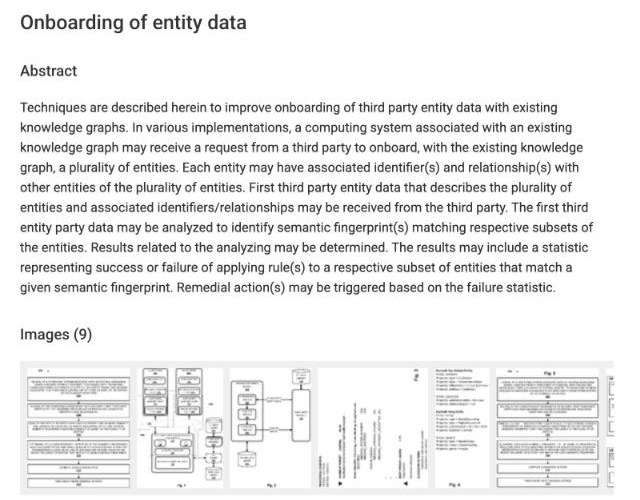
Entity matching. US-11361227-B2, “Onboarding of entity data” (Google, filed 2017, published 2022), describes a system tied to an existing knowledge graph. It receives entity data from a third party, with identifiers and relationships, and checks it against the graph. This shows that entities are matched to a graph by identifiers and relationships.
Entities in an index. US-9665643-B2, “Knowledge-based entity detection and disambiguation” (Microsoft, filed 2011), associates entity identifiers with a web page and stores them as metadata in the search index. It uses those entities to organize search results. It shows how a page level entity signal can serve a ranking system.
Leaked attributes. The Content Warehouse documentation lists entity annotation fields that map to this idea. RepositoryWebrefEntityAnnotations.topicalityScore is described as how related the entity is to the overall topic of the document. topicalityRank ranks entities by that score. RepositoryWebrefDetailedEntityScores.normalizedTopicality is the proportion of the document that talks about the entity.
Two more fields matter here. RepositoryWebrefSalientEntitySet holds the salient entities for a document, and isImplicit flags whether an entity is stated or only implied. GeostoreKnowledgeGraphReferenceProto.id holds the knowledge graph identifier that Koray treats as the truth anchor for an entity. Averaged across a site, these per page scores are a quantitative proxy for Central Entity dominance. That reading is Koray’s interpretation, not a confirmed signal.
Learn it in the course
Koray teaches the Central Entity in Topical Authority Course Lecture 1, the introduction to Koraynese, and in Lecture 5, which covers the Central Entity, Central Search Intent, and site-wide n-grams. Lectures 4 and 35 apply it to topical maps. The video lesson “Q4: Central Entity on the Homepage?” runs about 3 minutes.
The course page holds the full lesson series by Behzad Hussain. The roadmap shows where this term sits in the learning order.
Frequently asked questions
Can a site have more than one Central Entity?
Koray’s framework uses one Central Entity for the whole site. It can be a short compound, such as Germany plus Visa. If you need two unrelated entities, treat them as two sites or two separate content networks.
Is the Central Entity the same as my main keyword?
No. A keyword is a query. The Central Entity is a concept that exists in every language and anchors every page, URL path, and content brief.
How is it different from Source Context?
The Central Entity says what the site is about. The Source Context says who you are and how you earn from it. The same entity gives a different map for a visa consultant than for a travel agency.
Where should the Central Entity appear first?
On the homepage, next to the main action of the business, above the fold. Link your Quality Nodes from the main content and the navigation, and repeat the entity in the title tag, H1, and introduction of every page.

Written by
Personal Injury SEO Strategist, founder of Rank Brilliance, and Certified Semantic SEO Expert in Koray’s methodology. He built this free Semantic SEO course and its 96-term glossary. Based on Koray Tuğberk GÜBÜR’s framework.
Last updated · Book a call